



An Exclusive interview by Rossella Frigerio
Born in Nairobi and now based between Kenya and Australia, Sandra Githinji is a designer and curator currently undertaking a Creative Practice PhD at RMIT University, titled Constellations of Home, exploring home as a living, relational practice. Her work examines how the built environment carries and conceals cosmologies, ethics, and social structures, with a focus on Kikuyu architecture and the knowledge systems embedded in pre colonial forms of dwelling.
For our Future Folks issue, Githinji offers a view of the future shaped through remembering and reimagining. Her installations, writing, and teaching explore lineages of craft and community that colonial systems attempted to erase. In this conversation, she reflects on the spiritual technologies of Kikuyu architecture, her idea of “Constellations of Home,” and the work she is shaping for 2026.

In your first solo show earlier this year in Nairobi, you drew deeply from your ancestral roots and traditional Kikuyu architecture, key aspects of your practice more broadly. Could you share the spiritual and practical dimensions of Kikuyu architecture, and how you weave these into your contemporary work?
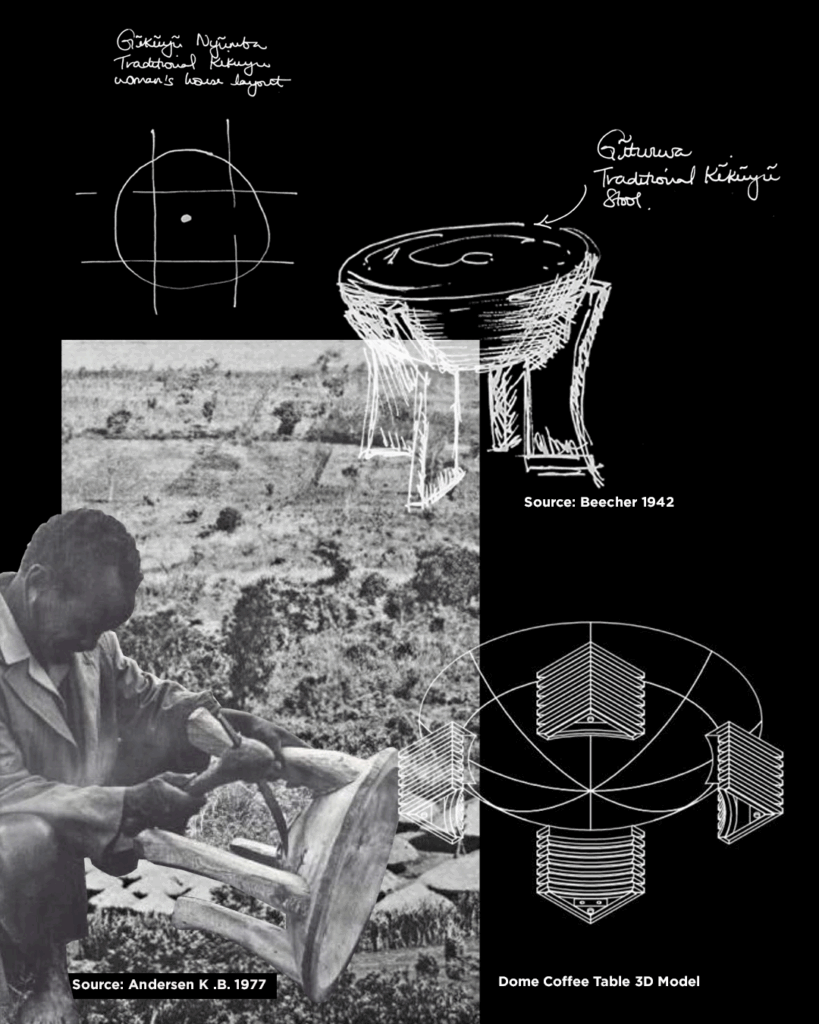
I’ve come to understand Kikuyu architecture not as something distant or historic, but as something that was always there, just hidden from me. Growing up, I spent every December visiting my grandparents in the central province of Kenya. Both sides of my family lived in what we would call modern homesteads: a main house built from corrugated steel, blockwork, and concrete. They were devoted Christians, so no visible trace of traditional practices or rituals remained. At the time, I did not even know there was a pre-colonial architectural worldview to reference. The traditional Nyumba (the woman’s house), Thigira (the man’s house), and Ikumbi (the granary) were entirely absent.

“The past is never gone; like starlight, it reaches us across time, long after transforming”.
When I began researching Kikuyu architecture as an adult, it felt less like learning something new and more like returning to a lineage that had been disrupted. That severance of inheritance, worldview, and spatial knowledge is deeply tied to colonial impositions. Texts such as A History of the Kikuyu 1500–1900 by Godfrey Muriuki and Professor Joseph Kamenju’s dissertation The Transformation of Kikuyu Traditional Architecture crystallised how dramatically our built environments were reshaped. Policies like the hut tax, the dispossession of land, the establishment of reserves, and the imposition of new materials and building typologies reconfigured domestic life and transformed entire social structures and ways of dwelling.
Because of this rupture, approaching each project feels like an invitation, sometimes even a provocation, to uncover what was lost or obscured. There is grief in that process. Discovering what was hidden forces you to reckon with all the ways knowledge was interrupted. But there is also the possibility of reclaiming, restoring, and continuing these architectural lineages in a contemporary context – not nostalgically, but as a form of living continuity.
This shaped my first solo exhibition, Coka Mucii – Rudi Nyumbani – Home Coming, held earlier this year in Nairobi. I was particularly drawn to the Nyumba and the Ikumbi, spaces that have held the social and spiritual lives of Kikuyu women for generations. The circular form of the Nyumba, grounded in sacred geometry and cosmology, became a central reference; its hearth echoes ancestral sites such as Mukurwe wa Nyagathanga, the mythical point of origin. The final installation measured five metres in diameter, aligning with the traditional Nyumba’s span. There is a Kikuyu saying, Mucii ni ndogo – the homestead is smoke. It reminds us that the hearth is more than a fire; it is the spiritual and familial centre where everyday rituals meet ancestral memory and cosmological grounding.
The Ikumbi, by contrast, offered a way to think about preservation and sustenance. It embodies the community’s relationship to shared labour, food, and generosity, values I wanted to honour and translate into the spatial language of the exhibition.
Materiality became another doorway into this rediscovery. Elephant grass, sourced from Sagana and Kajiado, was traditionally used for thatching before industrialisation shifted communities toward corrugated steel. For the floor, I chose a woven seagrass mat as a nod to coastal and riverine craft traditions, a reminder of how interconnected our material cultures are across Kenya.
What draws me to Kikuyu architecture is how fully it held our ethics, cosmology, and social relations. These structures were not just buildings; they were embodiments of how we understood life, community, gender, labour, and spirituality. Threading these elements into my contemporary work is really about asking: how do the spaces we build today reflect or distort how we want to live, and what might we recover if we look backwards to move forwards?
Exhibition-making has become a way to test these ideas publicly, to share this ongoing process of remembering and reimagining. Ultimately, my hope is to bring these insights into future architectural projects, creating space for these stories to remain active in our built environment.
“What draws me to Kikuyu architecture is how fully it held our ethics, cosmology, and social relations”.

“For me, the future is not a place we can grasp”.
What meaning does the word “future” hold for you?
For me, the future is not a place we can grasp. Kenyan philosopher and writer John Mbiti reminds us that it has not happened yet, so it does not truly exist. What we do have is the past and the present, and I am always paying attention to how the past folds into my work now. When I think about the future, I am really thinking about what we choose to do today – how our actions, values, and creative decisions in this moment shape whatever comes next.

“When I think about home, I am not seeking purity, origin, or resolution”.
You’ve said that “home” is something that constantly changes, regardless of its physical presence. What are the key elements of the vision of home as a constellation that you embrace?
When I think about home, I am not seeking purity, origin, or resolution. I am interested in a framework that understands home as relational, something that unfolds across geographies, temporalities, and scales all at once. I draw from Chicana feminist Gloria Anzaldúa, who reimagines the borderlands not only as physical boundaries but as psychic and cultural spaces where contradictions coexist and where living in-between becomes generative rather than deficient. Similarly, the academic Homi K. Bhabha’s idea of migrant double vision speaks to the capacity to hold homeland and host land, past and present, here and elsewhere, in productive tension.
This is what I call Constellations of Home. A constellation has no single centre. It is formed through relation, by drawing lines between scattered points. The past is never gone; like starlight, it reaches us across time, long after its source has transformed. Through this lens, I explore how home can be sensed across distance and rupture, not as a fixed site to return to, but as an ongoing navigation.

To think of home as a constellation is also to locate its liberatory force. It is not only an act of resistance against colonial narratives of fixed identity; it is a gesture toward freedom. As Saidiya Hartman reminds us, in the wake of dispossession we must “fashion beauty from the wreckage”, assembling a livable world from fragments. Constellation offers this possibility: it allows us to gather memory, grief, ritual, and joy without forcing them into coherence.
Here, liberation is not found in a return to an origin, but in the right to compose oneself otherwise. bell hooks speaks of homeplace as a “site of resistance”, a space we build to nurture the self against systems that deny our humanity. In my practice, the constellation becomes that space, a method of assembling belonging across distance, time, and relation.
“To think of home as a constellation is also to locate its liberatory force. It is not only an act of resistance against colonial narratives of fixed identity; it is a gesture toward freedom”.
Audre Lorde teaches that survival itself can be creative. Constellation embraces that creativity: it gives permission to imagine beyond the inherited script, to reclaim agency in how we remember, how we relate, and how we make and remake home. It insists that even within rupture, there is room for imagination.
What do you have on the horizon for 2026?
I am focused on finding practical and meaningful ways to share what is emerging from my PhD with people outside the academic space. Teaching sessionally has been such a gift. These classroom conversations have reminded me how transformative it is for people, particularly diasporans, to access grounded ways of thinking about home through their personal narratives.
This inspired Homegrounds, a new masterclass I am shaping. It draws from my own diasporic experience and the many conversations I have had with people who hold home both here and elsewhere. The masterclass will offer practical tools, creative inspiration, and a renewed sense of connection, guiding people to craft a personal and compelling narrative of home that honours where they come from and where they are now.
It feels like the right next step – taking the ideas I am researching and translating them into something people can use in their everyday lives.
Credits:
Photographer: Navraj Chana. Collage: Andersen K.B. 1977 and Beecher 1942
An Exclusive interview by Rossella Frigerio